


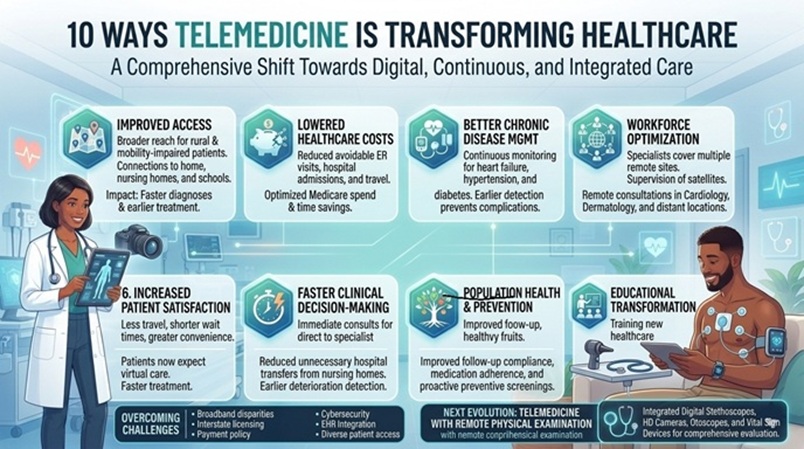
Telemedicine is transforming healthcare from an episodic, location-dependent model into one that is more continuous, accessible, and efficient. Its impact extends well beyond simple video visits, particularly as platforms increasingly incorporate remote diagnostic devices and clinical decision support.
Here are the major ways telemedicine is changing healthcare:
1. Improving Access to Care
Telemedicine has dramatically expanded access for patients who previously faced barriers to healthcare.
Rural and underserved communities gain access to specialists.
Elderly and mobility-impaired patients can receive care without traveling.
Patients in nursing homes, correctional facilities, schools, offshore locations, and at home can connect with clinicians more easily.
Wait times for appointments are often reduced.
Impact: More timely diagnoses and earlier treatment.
2. Lowering Healthcare Costs
Numerous studies have demonstrated that appropriately implemented telemedicine reduces costs by:
Avoiding unnecessary emergency department visits
Reducing hospital admissions
Lowering readmission rates
Decreasing transportation costs
Reducing time away from work
Improving chronic disease management
For Medicare populations alone, these savings can amount to billions of dollars annually when telemedicine prevents avoidable hospital utilization.
3. Better Chronic Disease Management
Patients with chronic illnesses benefit from frequent monitoring without frequent office visits.
Examples include:
Heart failure
Hypertension
Diabetes
COPD
Atrial fibrillation
Regular virtual follow-up often detects deterioration earlier, allowing intervention before hospitalization becomes necessary.
4. Addressing Workforce Shortages
Healthcare systems face shortages of physicians and nurses.
Telemedicine allows providers to:
Cover multiple locations
Supervise satellite clinics
Support nurse practitioners and physician assistants
Extend specialist expertise into underserved regions
This improves productivity without compromising access.
5. Expanding Specialty Care
Many specialties now routinely use telemedicine, including:
Cardiology
Psychiatry
Neurology
Dermatology
Endocrinology
Infectious disease
Critical care (tele-ICU)
Patients who once traveled hundreds of miles can often receive expert consultation from home.
The Next Evolution: Telemedicine with Remote Physical Examination
One of the traditional criticisms of telemedicine has been the inability to perform a physical examination.
This limitation is rapidly changing.
Modern platforms can integrate:
Digital stethoscopes
High-definition examination cameras
Otoscopes
Dermatoscopes
Ultrasound (in selected settings)
Vital sign monitoring devices
Digital ECG systems
Pulse oximetry
These tools enable clinicians to evaluate heart sounds, lung sounds, skin lesions, ear pathology, wounds, and other clinical findings remotely.
As a result, telemedicine increasingly supports a more comprehensive clinical evaluation rather than relying solely on history-taking.
6. Improved Patient Satisfaction
Patients consistently report high satisfaction because telemedicine offers:
Less travel
Shorter waiting times
Greater convenience
Easier access to specialists
Better continuity with their existing healthcare providers
Many patients now expect virtual care to be available as part of routine healthcare.
7. Faster Clinical Decision-Making
Telemedicine enables:
Immediate specialist consultation
Earlier diagnosis
Quicker referrals
Faster treatment initiation
This can be especially valuable in:
Stroke care
Cardiology
Trauma
Emergency medicine
Intensive care
8. Better Care in Long-Term Care Facilities
For nursing homes and assisted living facilities, telemedicine can:
Reduce unnecessary hospital transfers
Avoid disruptive emergency department visits
Detect deterioration earlier
Provide rapid specialist input
Support staff with timely physician evaluation
When combined with remote examination tools, clinicians can often assess residents more comprehensively without requiring transport to an acute care facility.
9. Population Health and Preventive Care
Telemedicine supports proactive healthcare by:
Increasing follow-up compliance
Improving medication adherence
Enabling preventive screenings
Facilitating patient education
Allowing remote monitoring of at-risk populations
This shifts care toward prevention rather than reacting after complications develop.
10. Educational Transformation
Telemedicine is reshaping the education of future healthcare professionals.
Medical, nursing, and allied health programs increasingly train students to:
Conduct effective virtual patient encounters
Use digital diagnostic equipment
Integrate remote examination into clinical reasoning
Manage hybrid care models
Deliver patient-centered care using digital technologies
As virtual care becomes a routine component of healthcare delivery, telemedicine competency is becoming an essential clinical skill.
Remaining Challenges
Despite its advantages, telemedicine still faces several hurdles:
Broadband and technology access disparities
Reimbursement and payment policy changes
Interstate licensing requirements
Cybersecurity and data privacy concerns
Integration with electronic health records
Training clinicians to perform high-quality virtual assessments
Ensuring equitable access across diverse patient populations
Addressing these challenges will be important to realizing telemedicine's full potential.
Looking Ahead
Telemedicine is evolving from a convenience service into a core component of healthcare delivery. The integration of remote diagnostic technologies, artificial intelligence, remote monitoring, and interoperable digital platforms is enabling clinicians to provide increasingly comprehensive care outside traditional clinical settings.
The future of telemedicine is likely to be hybrid, combining in-person care when necessary with virtual visits enhanced by remote examination and monitoring. This model has the potential to improve access, reduce costs, support an overstretched healthcare workforce, and maintain high-quality care across diverse settings.


